Conditions: Growth Mindset Culture
How culture can undermine mindset capability.
We find people are relieved and excited to develop a framework that guides their mindset. People leave with genuine insight into their fixed mindset triggers and practices to support them in the moments that matter.
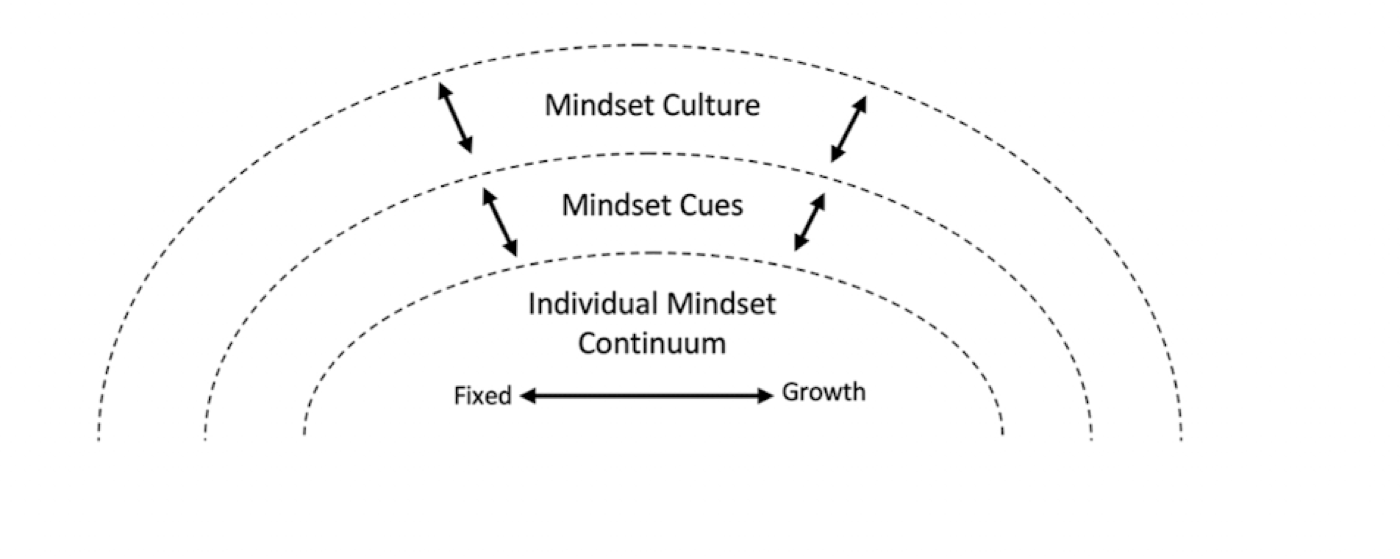
The challenge is that our mindsets are also cued by culture. When we return to the same meetings, the same performance reviews, the same approaches, it is difficult not to fall into fixed mindset patterns when growth behaviours are neither supported nor encouraged, and mindset certainty is low.
- 14%
- of how people read their company’s mindset is personal. The rest is the culture.
- 47%
- higher trust reported in cultures of growth.
- 5,000+
- employees mapped in the Mindset Profiler™ dataset.
Cultures of Genius. Cultures of Growth.
Culture sets the volume on what people are willing to act on.
Cultures of Growth
Collaborate, experiment, share.
Communicate that success comes through learning. Development opportunities are frequent. Struggle and setbacks are expected and valued for what they teach. These cultures prioritise learning goals, encourage collaboration, and measure risk-taking and innovation.
Cultures of Genius
Compete, hoard, cut corners.
Communicate that success belongs to the naturally talented. Development supports are devalued. Struggle signals that someone lacks what it takes. These cultures prioritise performance goals, encourage competition, and discourage risk-taking or learning from failure.
47% higher trust, stronger collaboration, and higher ethical standards reported in cultures of growth.2
A decade of Fortune 500 research identified two distinct culture types.1 The patterns are stable, observable, and self-reinforcing.
“Our fundamental belief is that our culture transformation and our company transformation is absolutely grounded in a deep understanding of a growth mindset.”Joe Whittinghill, corporate vice president of talent, learning, and insights at Microsoft
Experimental and field studies consistently show that cultures of growth promote collaboration, innovation, and integrity, while cultures of genius promote competition, risk aversion, and unethical behaviour. These effects persist after controlling for warmth and competence: mindset culture is a distinct construct, not a proxy for “being nice.”
In building a culture of growth, understanding the risk of a false growth mindset is important. Here is how the false growth mindset can operate at scale: an organisation espouses growth values, while its artefacts communicate fixed beliefs. CEOs announce that the growth mindset is a priority. Mindset values are communicated. Strategy documents are updated. Within weeks, every employee learns to use growth mindset language and bury their fixed mindsets. The intervention has changed what people are willing to say or do. It has not changed what the culture rewards. People perceive the implemented culture more accurately than the intended one. What leaders do matters more than what leaders believe.
This failure mode stems from a deeper habit. Organisational leaders and HR often focus on individual mindset, as if identifying and retaining ‘growth mindset’ employees would create a growth-minded organisation. The underlying assumptions are that mindset is static, entirely individual, and that an assessment will reveal the truth about whether someone has a growth or fixed mindset. When we affix these beliefs to individuals, they, in turn, affix them to others.
Mindset culture is an active, collaborative creation at the group and organisational level. The culture surrounding us is one of the biggest influences on our beliefs, motivations and behaviour.
Once we accept this, the questions worth asking change.
The question is not: “Are you a person with more of a fixed or growth mindset?” The question is: “When are your fixed mindset triggers active, and when are you in your growth mindset?”
At the organisational level, the question is not: “How can we avoid hiring fixed-mindset people?” The question is: “What triggers our people to adopt more fixed- or growth-mindset states and behaviours? How can we shape the environment to encourage more growth mindset beliefs and behaviours in the moments that matter and more of the time?”
Prof Carol Dweck is direct about what works. “To be effective, interventions must resonate with people’s experiences. They must situate those experiences within the growth-mindset-meaning system. The intervention needs to help people recognise and reflect on their fixed mindset triggers. Telling people the facts about a growth mindset and expecting them to change produces a false growth mindset. Helping people recognise where their fixed mindset triggers are active and giving them the skills and practices to respond differently in those moments produces the change.”
In aiming to evaluate people’s mindset set points, organisations end up placing an inordinate amount of focus on what people bring and not enough on how the environment supports or hinders their mindsets. This is why fixed mindset trigger work sits at the centre of culture change. Triggers are the moments when culture meets individual response. Redesigning the conditions around those moments is how culture moves.
Same people. Different culture. Different behaviour.
14%
of how people read their company’s mindset is personal. The rest is the culture.
People’s personal mindset beliefs account for only 14% of the variance in how they perceive their company’s beliefs.3 The rest is influenced by the company culture. Mindset is a meaning-making system. Culture is the environment that activates either a fixed or growth mindset response.
A leader who believes in potential enters a performance system that sorts people into top, middle, and bottom. Within months, the leader is assessing rather than developing, because the cultural cue is louder than the leader’s belief. The culture did not influence the leader’s mind. It changed the leader’s behaviour. This is why it is critical that mindset interventions are led by senior leaders, who clarify what is important to their company culture and how it translates into everyday moments and interactions.
How culture works.
Edgar Schein’s model of organisational culture sets out three layers.
- Layer 01 · Deepest, invisible
Foundational beliefs.
The deepest layer is the embedded beliefs an organisation holds about what talent is, who has it, and whether it can be developed.
- Layer 02 · Stated, audible
Espoused values.
The middle layer is the values your organisation states out loud in vision statements and frameworks. It is easy to declare and hardest to evidence.
- Layer 03 · What people meet
Artefacts.
Who gets promoted and why. How feedback is delivered when something goes wrong. How people raise difficult issues.
Two of the layers are invisible. The third is what people encounter when they turn up for work. When all three align, culture feels coherent. When they do not align, people can sense the gap and trust what they see and feel. As a result, they will take actions that reflect the incoherence4.
Foundational beliefs. The deepest layer is the embedded beliefs an organisation holds about what talent is, who has it, and whether it can be developed. This is not articulated and is often inherited from founders, reinforced by promotions, and protected by the absence of overt conversations. They show up in questions that never get asked.
Espoused values. The middle layer is the values your organisation states out loud. Vision statements, leadership messages, competency frameworks. This is the layer the marketing reaches. It is the easiest to declare and the hardest to evidence.
Artefacts. The top layer is what people actually encounter:
- Who gets promoted and why.
- How feedback is delivered when something goes wrong, when a challenge or opportunity presents itself.
- What happens to the person who says “I don’t know” in a room full of senior leaders.
- The way mistakes get handled when it is high stakes.
People read an organisation’s mindset from its artefacts. Then they adjust. When the three layers align, culture is coherent. People know what to expect. When they do not, people experience a gap between what the organisation says and what it does. They resolve that gap fast. They trust what they see and experience.
As part of validating the Mindset Profiler™, Susan Mackie, John Rives, Professor Carol Dweck, Professor Mary Murphy, and Associate Professor Katie Muenks examined how leaders’ mindset beliefs shaped their teams at a large multinational bank.
Growth mindset managers normalise struggle. They invested time in all employees, not just the stand-outs. They recruited the whole team when colleagues struggled, treating challenges as “ours.”
Fixed mindset managers preferred star performers. They assigned dull tasks to those perceived as having less potential. They reassured struggling employees by suggesting the task “simply wasn’t their area of strength.” They invested in those they saw as talented and managed everyone else.
In a research project, managers randomly assigned to a mindset programme were coached more often and more effectively, and recognised genuine improvement in employees whose earlier performance had been poor. Fixed-mindset managers, watching the same improvement, remained anchored to their original assessment. The programme had not changed the employee’s ability. It had changed what the manager could see.
People read an organisation’s mindset from its policies, systems and practices. They adjust5.
In a culture of genius, newcomers learn to highlight awards and achievements. Intelligence becomes central to their identity. When they hire, they choose candidates who look like them. The culture becomes more entrenched.
In a culture of growth, newcomers highlight their motivation and the challenges they have overcome. Learning becomes central to identity. When they hire, they choose people who can further support and grow the team with new skills or insights. The culture expands and grows.
Both cycles are self-reinforcing, and can vary from team to team.
Which culture is most active in your teams or overall culture?
How a culture activates fixed mindset triggers.
Interventions that target only the individual, while leaving the contextual cues unchanged, produce insight without behaviour change. Mindset resides both in people and organisational cues.
Research identifies four organisational triggers that culture broadcasts every day.6
Evaluative situations.
We are pushed into prove-and-perform mode, which narrows performance goals rather than advancing things.
High effort situations.
Success becomes contingent on proving that we can do things with ease, and if it requires more effort, time, or slower learning, we lack talent.
Feedback.
We perceive feedback as a pronouncement of whether we are good or bad at our job or at a particular skill or task. We can see it as a pronouncement rather than possibilities.
Success of others.
This creates a zero-sum mentality when we are routinely evaluated and placed in brackets, with those at the top rewarded. This erodes teamwork and collaboration.
Read about the eight personal triggers →
Fixed mindset triggers do not live only in people. They are also activated by the culture around them. The triggers operate at three levels: personal triggers, the eight measured by the Mindset Profiler™; and team and organisational triggers, drawn from the aggregated Profiler data. Each describes a cultural moment that cues people whether learning or prove-and-protect is the right response.
These patterns were identified during the development of the Mindset Profiler dataset across 5,000+ employees, and later converged with research on organisational mindset. In our fieldwork, we found that people could show clear insight into their fixed mindset triggers and even short-term changes in behaviour. Those changes did not persist when the organisational culture cued that visibility, experimentation, or help-seeking was unsafe.
Fixed mindset triggers are not activated in a vacuum. They are activated in settings that broadcast signals of rank, belonging, punishment, and permission. In the work we have done with organisations, we find that these cues are often more predictive of whether a new behaviour would consolidate than the person’s verbal endorsement of growth mindset beliefs.
Evaluative situations. Performance reviews, ranking systems, including individual sales goals without team sales, and recognition events. When a culture is built around sorting people rather than developing them, it broadcasts a fixed view of ability. Microsoft’s stack-ranking system is the canonical illustration.
High effort situations. What the culture says about people who appear to work hard. In talent-celebrating cultures, visible effort signals lack of ability. In learning-oriented cultures, visible effort signals investment in mastery. The same behaviour, read in two ways, depending on the cultural cues.
Feedback. How bad news, a failure or a mistake is delivered and received. What is important is how it is treated: as data to learn from or as a measure of a person’s or a team’s capability. The Setback and Feedback triggers on the personal side map onto the design of feedback and failure rituals on the organisational side. They both move together.
Success of others. Whether a colleague’s gain is built on someone else’s loss. Ranking and zero-sum reward systems convert peers into competitors by design. The Success of others, on the personal side, is amplified or quietened by how the organisation chooses to measure people against each other.
This is why fixed mindset trigger work is foundational to culture change. Culture redesign without fixed mindset trigger insight, and without the practices that support growth behaviours, produces a false growth mindset at scale: language without the practices, rituals, and behaviours.
Personal trigger work without a culture redesign produces exhausted, cynical people, leaders, and teams in conflict with the cultural cues that support a culture of genius. A culture of genius is not always organisation-wide; it can also reside in individual teams.
Microsoft. Kurt Eichenwald’s August 2012 Vanity Fair cover story10 documented the toxic culture inside Microsoft before Satya Nadella took over. Eichenwald wrote: “Every current and former Microsoft employee I interviewed, everyone, cited stack ranking as the most destructive process inside of Microsoft. The behaviour this engenders, people do everything they can to stay out of the bottom bucket.” One Microsoft engineer added: “People responsible for features will openly sabotage other people’s efforts. One of the most valuable things I learned was to give the appearance of being courteous while withholding just enough information from colleagues to ensure they didn’t get ahead of me on the rankings.” The system trained employees to look good rather than do good. Microsoft’s culture rebuild under Nadella began by dismantling it.
An Australian insurance company. A personal insurance company was failing its customers at the point of making a claim. NPS sat at −6. When the Mindset Profiler™ mapped the organisation, 65 per cent of employees showed strong activation of the Success of Others trigger, compared with a normal range of 16 to 18 per cent. Two-thirds of the workforce found their colleagues’ success threatening. A stack-ranking performance system was driving it. The organisation removed the ranking and built a learning goal structure alongside performance goals. The trigger pattern changed across the entire company. NPS rose from −6 to +26 within three months. The performance system was the trigger, not people’s behaviours.
Not all cues carry equal weight. The CEO’s beliefs have the strongest impact on how people perceive the organisation’s mindset. A leader’s beliefs shape the team. A new hire’s beliefs barely register. Culture change that targets only people, and not senior leaders, will not produce the change.
Fixed-minded cultures do not affect everyone equally. People whose abilities are already questioned by stereotype or structure, women in certain disciplines, people from racialised or working-class backgrounds, and first-generation professionals experience more threat, lower belonging, and larger performance gaps in cultures of genius.7
A study of 150 STEM faculty members found that racial achievement gaps doubled in classes taught by professors who endorsed more fixed mindset beliefs.8 The professor’s individual intention was irrelevant. The structure communicated a fixed view of ability regardless.
Reducing that gap is not an HR initiative. It is the responsibility of the senior leadership team.
Developing cues for growth.
The human moments that matter.
Develop leaders to model growth behaviours.
The CEO’s beliefs and values about people set the weather for the culture.
Revise performance management.
Design evaluation for performance outcomes and learning goals for mastery.
Design daily rituals that broadcast growth.
How meetings are run, feedback is given with care and candour, and setbacks are debriefed for learning, not judgement.
Create conditions for mindset certainty.
Make it safe to grow on the edge by taking risks, learning from mistakes, and getting support to manage mindset drift.
The dignity of work is a critical pillar of a healthy and successful workplace, but business pressures, new technology, and not redesigning the ways of working are eroding it. If people are not motivated, lack the mindset capability to meet the demands in front of them, and have no agency over how they work, they cannot be expected to deliver first-rate products, services, and experiences to customers. People need to trust that their leaders have their mindsets at heart, and that this work is not only about “improving productivity,” as people are already at their cognitive limit.
Shaping culture means redesigning the organisational triggers that undermine continuous change. It starts with a shared understanding of what supports a culture in turbulent times, while people and teams grapple with shifting expectations and uncertain futures. Organisations need to bring everyone along as they adopt new skills and tools for mindset capability, reinvent how work is done, and build the learning capabilities, business models, and innovation practices that unearth new directions.
The interventions that follow are specific, evidence-grounded, and led from the top. None of them requires a transformation programme to start changing. Each one redesigns what the culture is broadcasting in the moments that matter.
Develop growth-oriented leadership. Train senior leaders to model growth mindset behaviours and support employee development. The CEO’s beliefs have the strongest impact on how people perceive the organisation’s mindset, so leadership development is not an HR initiative. It is the lever.
Revise performance management. Move evaluation from outcome-only to a mix of outcome, effort, learning, and improvement. Remove ranking systems that convert peers into competitors. Build learning goals alongside performance goals so the system rewards how people get to the result, not only the result.
Design daily rituals that broadcast growth. How meetings open. How feedback is delivered. How bad news is received. How setbacks get debriefed. How success gets celebrated. When errors surface early in an environment that treats them as usable data, the brain encodes the corrective information that prevents repetition.9 When errors stay hidden, that corrective signal never activates and the organisation keeps making the same mistake.
Create psychological safety, address bias, encourage collaboration. Build an environment where employees feel safe to take risks, share ideas, and learn from mistakes. Put in place diversity and inclusion practices that challenge stereotypes and broaden who is seen as capable. Make knowledge-sharing and cross-functional learning the default through team structures and collaborative projects.
A government agency came to us with teams locked in passive-aggressive patterns: disengaged, siloed, unwilling to own problems or cross departmental lines. The programme for around 800 employees is anchored in mindset triggers, goal pursuit, clarity, accountability, and feedback, practised in daily behaviours rather than aspirational ideas.
The results. Passive-aggressive interactions, which had accounted for 84 per cent of team exchanges, dropped to 15 per cent. Constructive interactions increased by 120 per cent. The employee engagement score beat the Australian national norm for the first time.
The people were the same. The operating conditions changed, and the behaviour changed with them.
Mindset capability is the work.
Business pressure and continuous change. AI absorbing the execution layer. New ways of working are needed, with organisations constantly needing to reinvent. These are the conditions we work in now. It is not slowing down.
In a moment like this, the differentiator is no longer what your organisation knows. It is what your people can do with what they know when the situation is unfamiliar, when the stakes are high, when the answer is not in the playbook.
This is a mindset capability. The ability to remain growth-oriented, to learn in public, and to recover from a setback quickly. The ability to lead in conditions where leaders have to have clarity in how they show up and place their people in the heart of the change.
Mindset capability is how organisations deliver first-rate products, services, and experiences to customers while honouring the dignity of work: the personal agency, support, and conditions people need to develop their mindset and learning potential. The work is not optional. It is also not solo. Mindset capability is built with people, supported by leaders, and held by the culture. All three layers need to move together.
Take the Profiler
Map the fixed mindset triggers for yourself, your team, or your organisation.
The Mindset Profiler™ measures eight trigger dimensions. Fifteen minutes. Benchmarked against 90,000+ profiles across 500+ organisations in 40+ countries.
References.
- 1. Canning, E. A., Murphy, M. C., Emerson, K. T. U., et al. (2020). Cultures of genius at work: Organisational mindsets predict cultural norms, trust, and commitment. Personality and Social Psychology Bulletin, 46(4); Murphy, M. C., & Dweck, C. S. (2010); Murphy, M. C. (2024). Cultures of Growth.
- 2. Canning et al. (2020); Emerson, K. T. U., & Murphy, M. C. (2015); Jones, M. et al. (2024).
- 3. Canning et al. (2020). Personal beliefs vs organisational perceptions, 14 per cent variance.
- 4. Schein, E. H. (1990, 1996, 2010). Organisational Culture and Leadership. Three-layer model: underlying assumptions, espoused values, artefacts.
- 5. Murphy, M. C., & Dweck, C. S. (2010). Self-reinforcing mindset culture cycle.
- 6. Murphy, M. C., & Reeves, S. L. (2020). Personal and organisational mindset at work. Research on Managing Groups and Teams: the four organisational triggers (evaluative situations, high effort situations, feedback, success of others).
- 7. Canning, E. A., Murphy, M. C., et al. (2019, 2022); Emerson & Murphy (2015); LaCosse, J., Murphy, M. C., Garcia, J. A., et al. (2021).
- 8. Canning, E. A., Muenks, K., Green, D. J., & Murphy, M. C. (2019). STEM faculty who believe ability is fixed have larger racial achievement gaps and inspire less student motivation in their classes. Science Advances, 5(2).
- 9. Van Dyck, C., Frese, M., Baer, M., & Sonnentag, S. (2005). Organisational error management culture and its impact on performance. Journal of Applied Psychology, 90(6).
- 10. Eichenwald, K. (August 2012). Microsoft’s lost decade. Vanity Fair. Stack-ranking system documented through interviews with current and former Microsoft employees.